
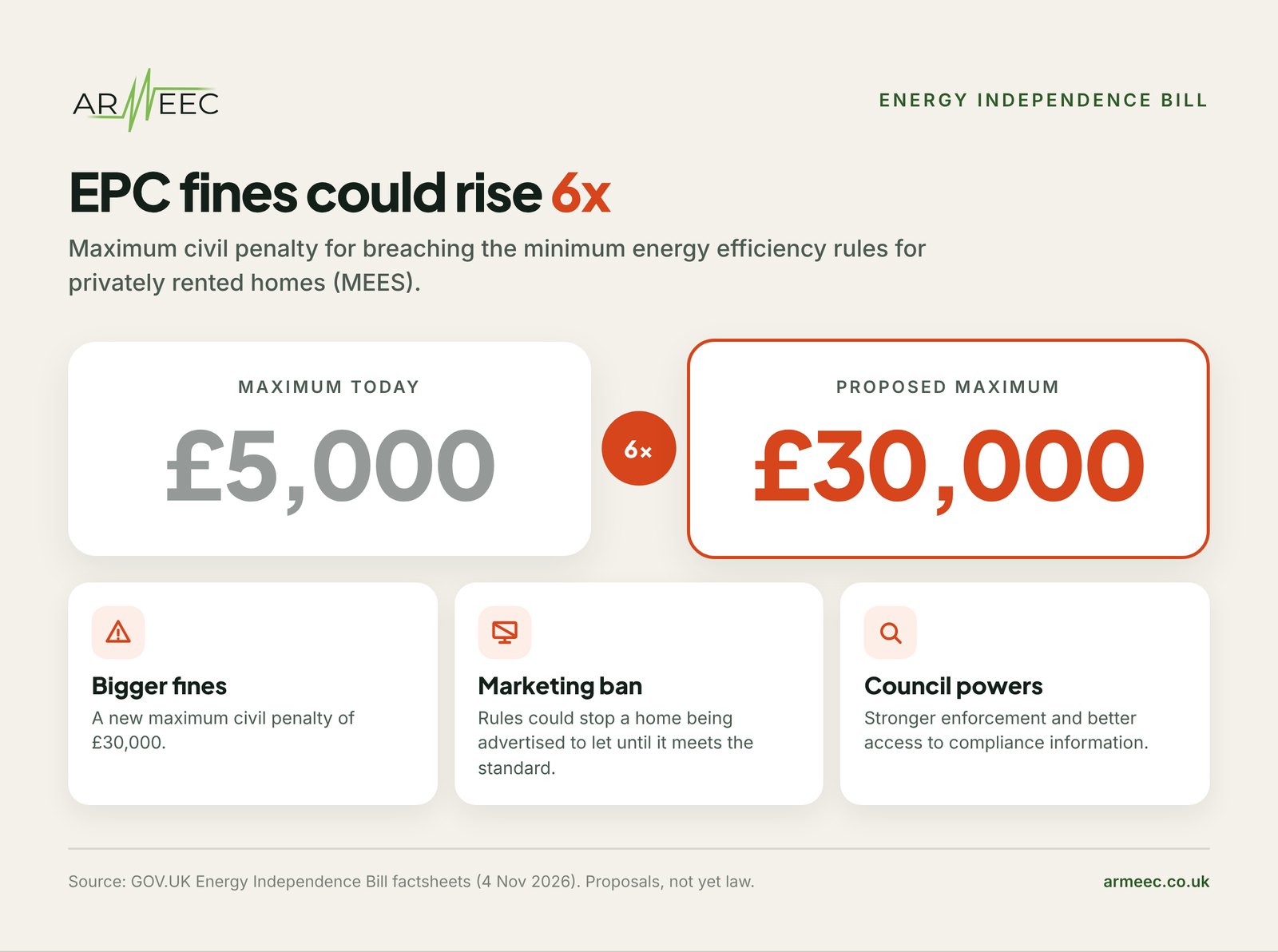
The maximum fine for letting out a home that breaks the energy efficiency rules could rise from £5,000 to £30,000. That’s six times higher, and it’s part of the Energy Independence Bill, which the government introduced to Parliament on 4 November 2026.
It’s a big headline, and it’s understandable if it makes you nervous. But the Bill isn’t law yet, and the most important date for landlords hasn’t changed. Here’s what’s actually being proposed, what it means in practice, and what to do now.
The short answer
- The Energy Independence Bill would raise the maximum civil penalty for breaching the minimum energy efficiency rules for rented homes from £5,000 to £30,000.
- Rules made under it could stop landlords and agents advertising a home to let until it meets the minimum standard.
- Councils would get stronger enforcement powers and better access to compliance information.
- It’s not law yet. The Bill has to pass Parliament, and the detailed rules will come later in regulations.
- The target is unchanged: privately rented homes need EPC C by 1 October 2030, with a £10,000 spending cap.
What is the Energy Independence Bill?
The Energy Independence Bill is a wide-ranging energy bill from the Department for Energy Security and Net Zero. Most of the coverage has focused on energy bills and standing charges, but one part deals with the private rented sector. The government has published a factsheet on enforcing the minimum energy efficiency standards alongside the other Bill factsheets.
Those standards, known as MEES, are the rules that set the minimum EPC rating a privately rented home must have. At the moment the minimum is E, unless a valid exemption is registered.
How much could EPC fines rise to?
According to the government’s factsheet, the Bill “will introduce a new maximum civil penalty of £30,000 for landlords found to be in breach” of the 2015 regulations. The current maximum for domestic breaches is £5,000.
One thing that isn’t clear yet is whether £30,000 is a single maximum or applies per property, per breach. Property118 notes that the government had proposed up to £30,000 per property, per breach back in January 2026. The final approach will be set out as the rules are developed.
Could you be banned from advertising a rental with a low EPC?
Potentially, yes. As the Landlord Law Blog explains, the Bill would allow regulations to prohibit landlords and agents from marketing a property to let until it meets the minimum standards.
In practice, that would mean checking your EPC before a property goes on the market, not after a tenant is found. For agents, it could become part of the standard onboarding checks.
What other powers does the Bill include?
- Stronger council enforcement: local authorities get enhanced powers to enforce the standards across domestic and non-domestic rentals.
- Better compliance information: councils would find it easier to identify non-compliant homes, and compliance records will probably be kept in a new database.
- Reporting: enforcement authorities would have to report the action they take.
- HMOs and rooms: rules could apply to part of a property, so rooms let separately in an HMO could be covered.
- Short-term lets: the Bill includes a power to cover licence arrangements, such as holiday lets, but the government says it has no plans to use it at this time.
It also creates a framework to move energy efficiency schemes to a new Warm Homes Agency, which Propertymark says should give landlords a clearer source of advice and support.
Is the £30,000 fine law yet?
No. This is the most important point to understand.
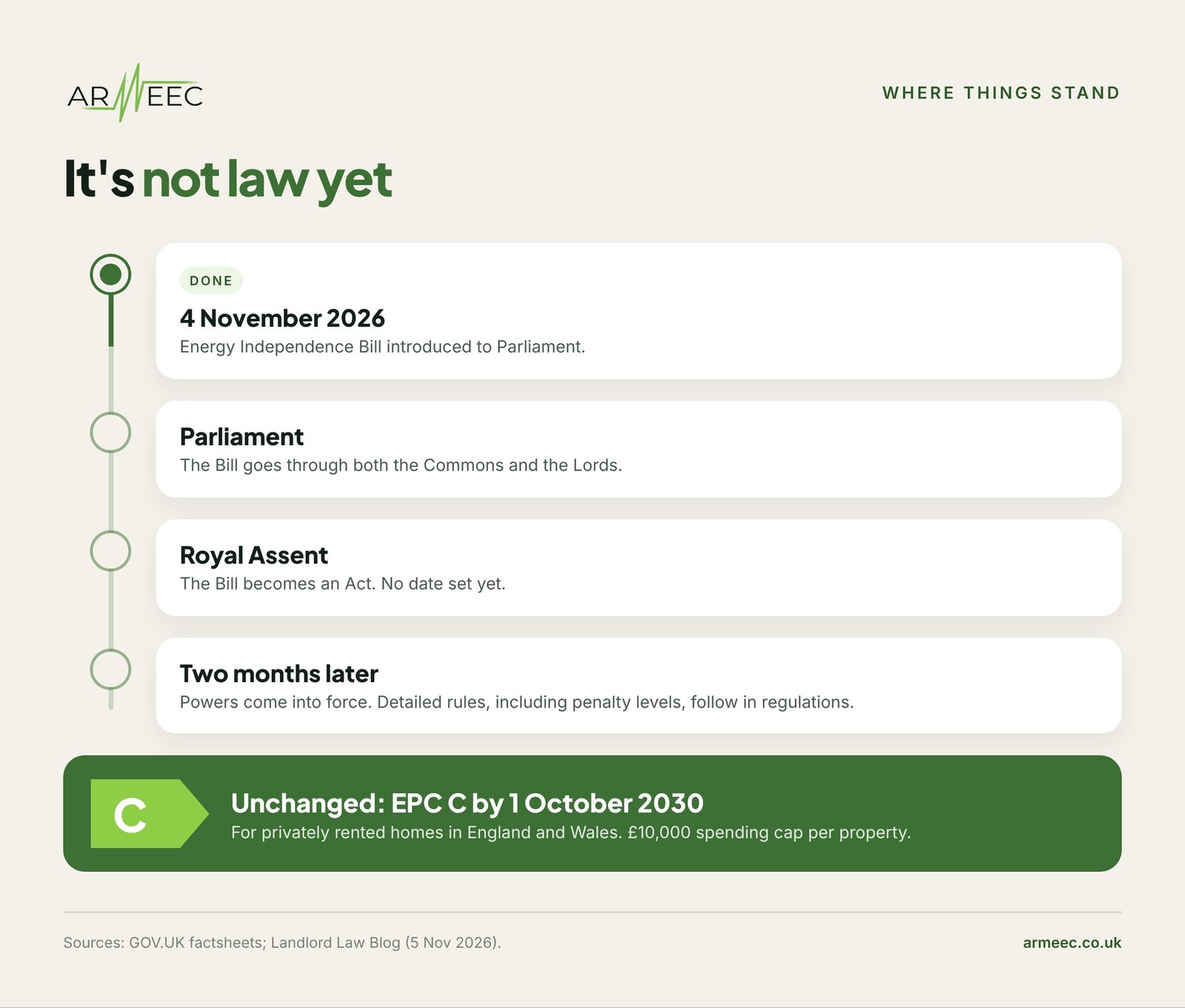
- 4 November 2026: the Bill was introduced to the House of Commons.
- Royal Assent: it has to pass through both Houses of Parliament first. No date has been set.
- Two months later: the relevant powers would come into force. Even then, these are powers to make rules. The detailed rules, including the actual penalty levels, will be set out in regulations afterwards.
So nobody is going to be fined £30,000 next month. But the direction is very clear: enforcement is going to get stricter.
What hasn’t changed: EPC C by 2030
The target date for landlords is still the same. Privately rented homes in England and Wales need to reach EPC C by 1 October 2030, unless an exemption applies. The spending cap is £10,000 per property, and qualifying work carried out from 1 October 2025 counts towards it.
If you’d like the full background, our guide on what landlords must do for EPC C by 2030 explains how the cap works. We’ve also covered why the new EPC has been delayed to 2027, and why 0% VAT on insulation, heat pumps and solar ends in March 2027.
What landlords should do now
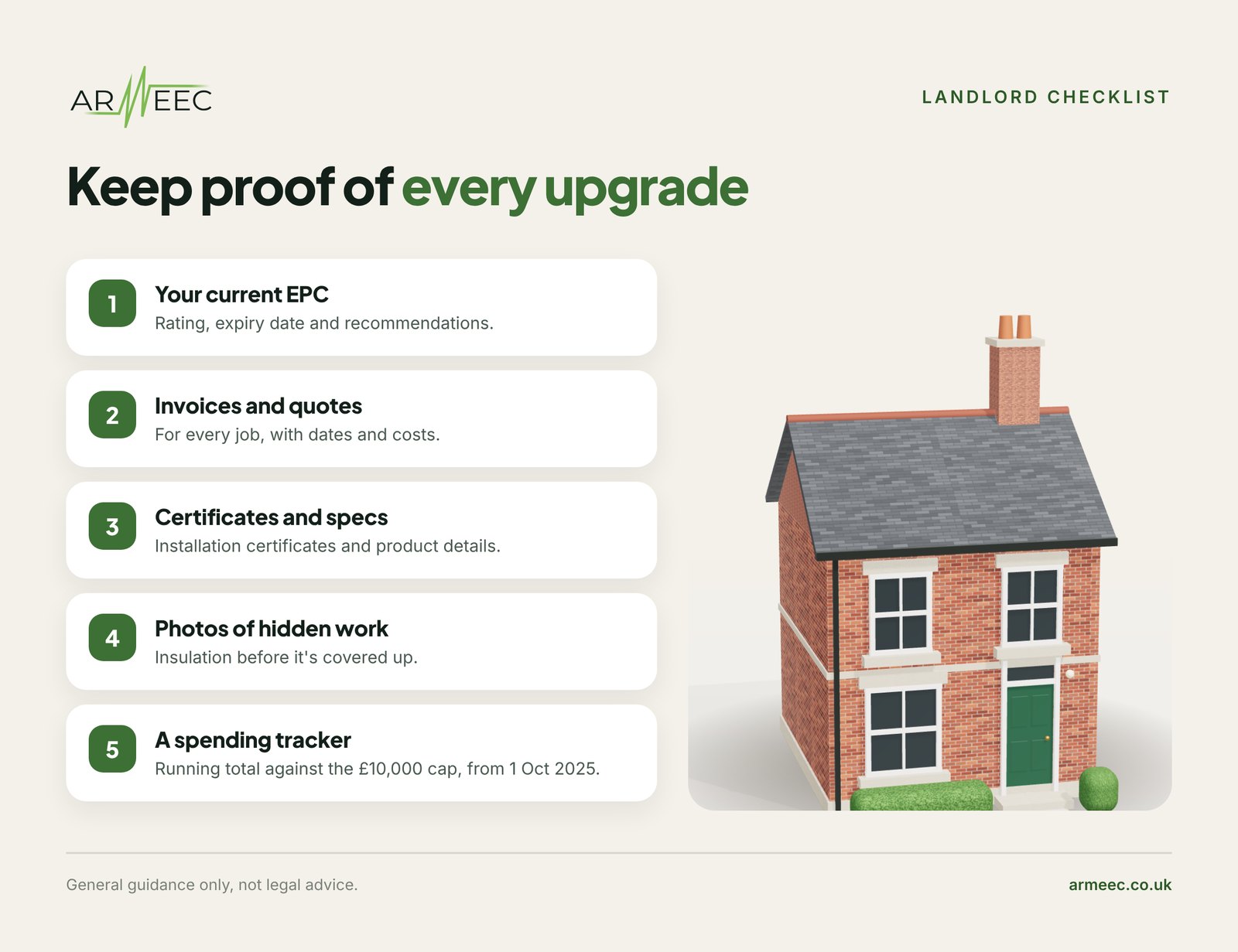
Bigger penalties make one thing much more important: being able to prove what you’ve done. Here’s a practical checklist.
- Check your current EPC. Look up the rating and expiry date on the GOV.UK EPC register. It’s free.
- Read the recommendations. Your certificate lists the improvements most likely to lift your rating.
- Plan and get quotes early. Installers are likely to get busier as 2030 gets closer, and the 0% VAT rate ends on 31 March 2027.
- Keep proof of every job. Invoices, specifications, installation certificates and photos. Photograph hidden work, like loft or floor insulation, before it’s covered up.
- Track your spending. Keep a running total against the £10,000 cap, including qualifying work since 1 October 2025.
- Check before you advertise. Make sure the property meets the standard before it goes on the market.
How ARMEEC can help
An up-to-date EPC is the starting point for all of this. ARMEEC’s Elmhurst-accredited assessors carry out EPCs across London and the UK, and we’ll explain exactly which improvements would move your property towards EPC C. Get a free, fixed-fee quote and we’ll come back to you within 24 hours.
Frequently asked questions
What is the maximum fine for breaking EPC rules as a landlord?
Today, the maximum penalty for breaching the domestic minimum energy efficiency rules (MEES) is £5,000. The Energy Independence Bill, introduced on 4 November 2026, would allow that to rise to £30,000. It is not law yet.
Is the £30,000 EPC fine per property?
That hasn’t been confirmed. The government’s factsheet sets a new maximum of £30,000 but doesn’t say whether it applies per property or per breach. The detail will be set out in regulations later.
When will the £30,000 penalty come in?
Not yet. The Bill has to pass through Parliament first. The powers would start two months after Royal Assent, and the detailed rules would then be set out in regulations.
Can a landlord be stopped from advertising a property with a low EPC?
The Bill would allow regulations to stop landlords and agents marketing a property to let until it meets the minimum energy efficiency standard. The exact rules haven’t been published yet.
Do privately rented homes still need EPC C by 2030?
Yes. The government’s target is for privately rented homes in England and Wales to reach EPC C by 1 October 2030, with a spending cap of £10,000 per property. Qualifying work carried out from 1 October 2025 counts towards the cap.
Sources: GOV.UK, Energy Independence Bill factsheet: domestic private rental sector MEES enforcement (4 November 2026); Landlord Law Blog (5 November 2026); Propertymark (5 November 2026); Elmhurst Energy (5 November 2026). This article is general guidance, not legal advice.